Write in Graham. Rank Troy second.
This is exactly what happens to that ballot.
Five steps. Each one is a sentence of Maine law, quoted exactly, with a screenshot of the Legislature’s own page so you can check that we did not trim anything.
Read on August 25, 2026. The Revisor’s site states its data was extracted October 20, 2025. A plain reading of published statutes by volunteers — not legal advice, and not confirmed by the Secretary of State.
We read the law. Writing Graham in does not waste your ballot.
A screen walkthrough of the statutes: what happens to a ballot that writes Graham in first and ranks Troy Jackson second. 2 min 46 sec, captioned.
It starts with one form and a deadline.
A write-in candidate is only a candidate if a declaration is filed with the Secretary of State by 5 p.m. on the 70th day before the election. No fee, no signatures. A form and a clock.
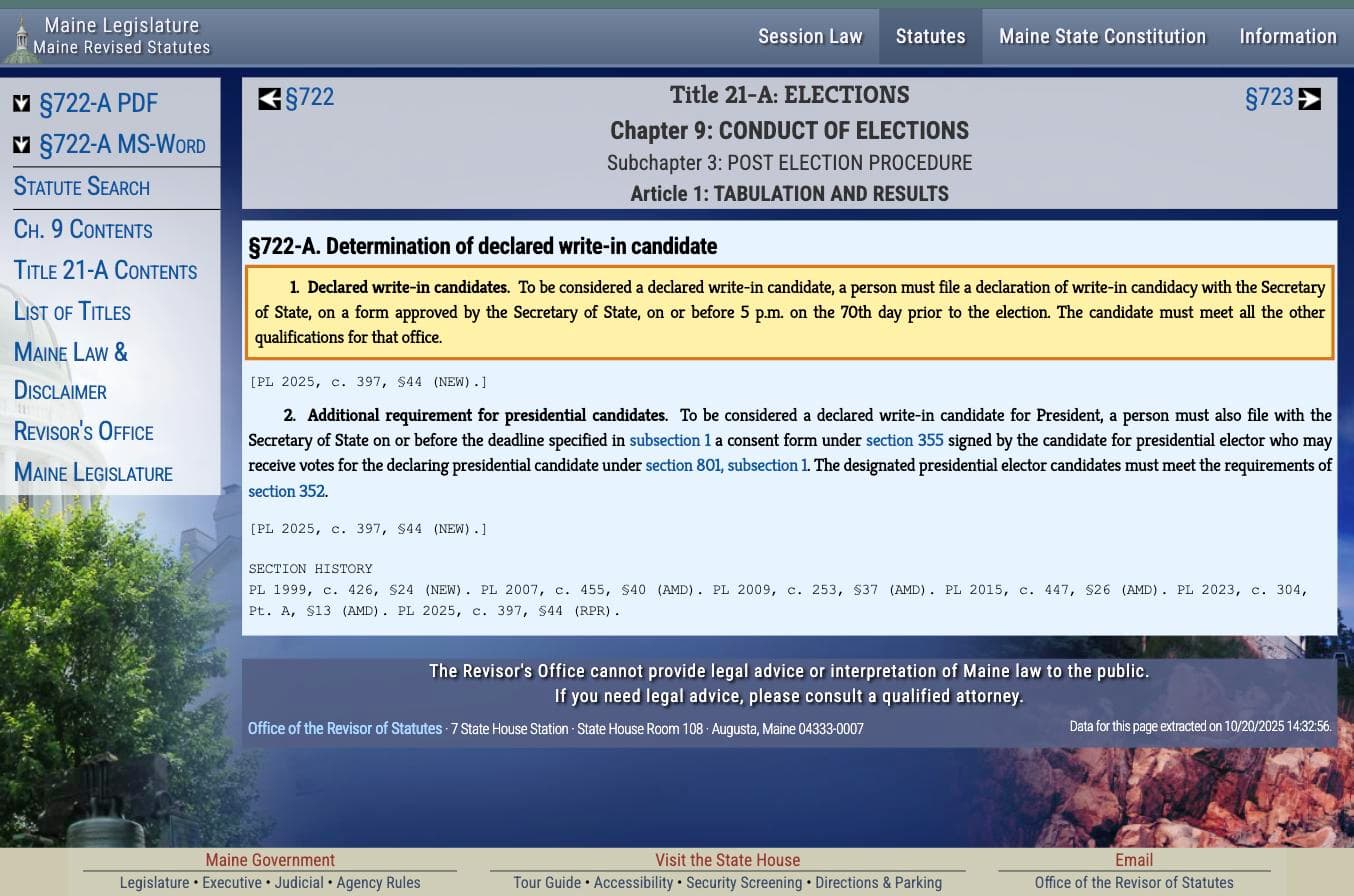
To be considered a declared write-in candidate, a person must file a declaration of write-in candidacy with the Secretary of State, on a form approved by the Secretary of State, on or before 5 p.m. on the 70th day prior to the election. The candidate must meet all the other qualifications for that office.
Without that filing, a write-in for him is not counted for him.
This is the sentence everything turns on, and it is not ambiguous. If he does not file, votes written in for him do not count toward his total. We are not going to soften that.
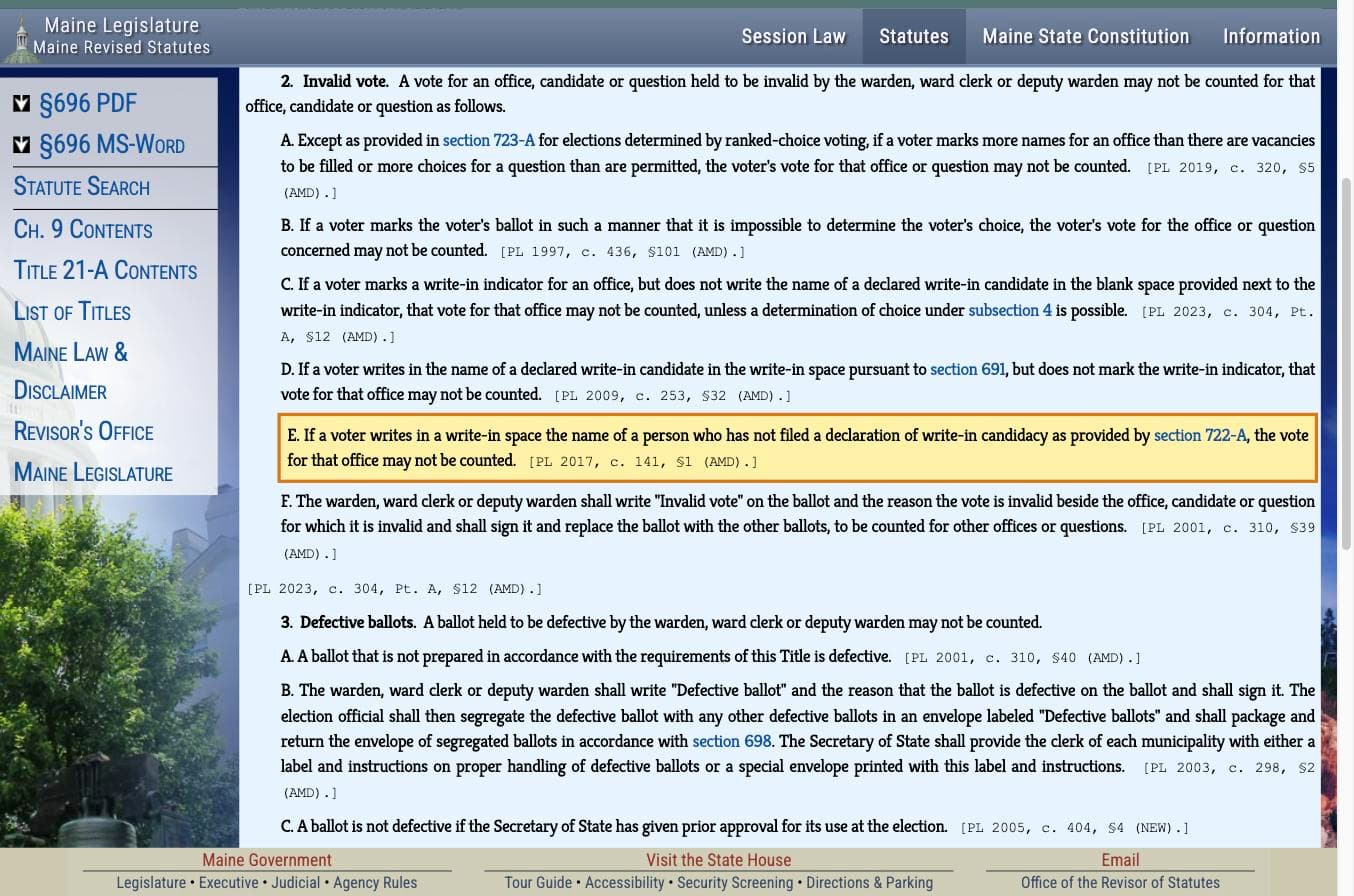
If a voter writes in a write-in space the name of a person who has not filed a declaration of write-in candidacy as provided by section 722-A, the vote for that office may not be counted.
That ranking stops working — and it does not matter which way you read why.
Some read the mark as a skipped ranking; others argue the ranking is not blank at all, so nothing is skipped. Take either. Under both, exactly ONE ranking on your ballot is affected. That is the point that survives the argument.
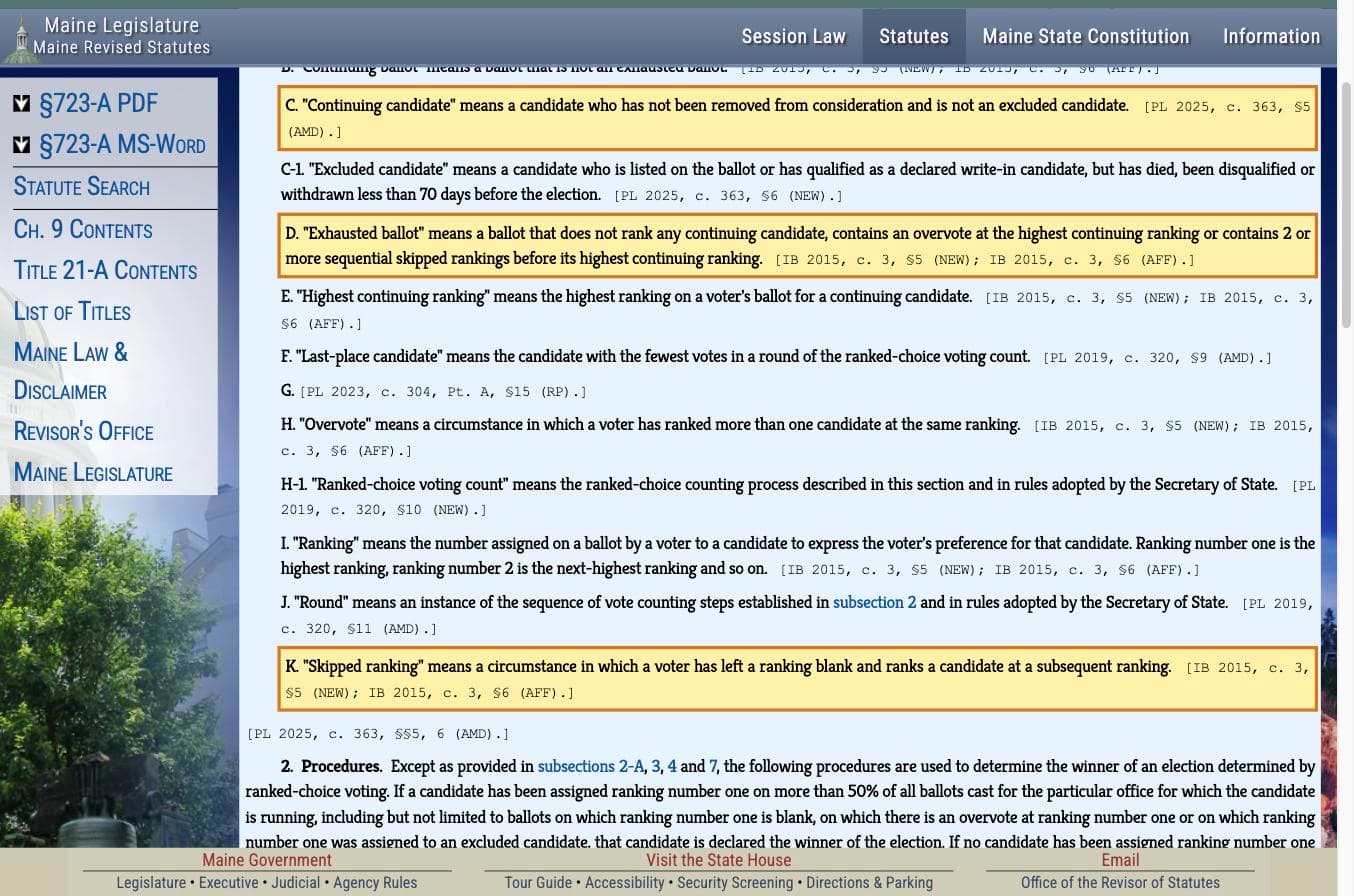
"Skipped ranking" means a circumstance in which a voter has left a ranking blank and ranks a candidate at a subsequent ranking.
One affected ranking never kills a ballot. It takes two in a row.
A ballot is exhausted only on 2 or more SEQUENTIAL skipped rankings. One is never enough. This is why writing a name in cannot spoil your ballot, and why nobody can be a spoiler by doing it.
"Exhausted ballot" means a ballot that does not rank any continuing candidate, contains an overvote at the highest continuing ranking or contains 2 or more sequential skipped rankings before its highest continuing ranking.
So your ballot counts for your next choice — in the first round.
Write in Graham first, rank Troy Jackson second, and in a ranked count that ballot counts for Jackson as the highest-ranked candidate still in the race. Not a later round. That one. The condition: rounds only run if nobody clears 50% of first rankings outright — and if someone does, nobody's second choice mattered anyway.
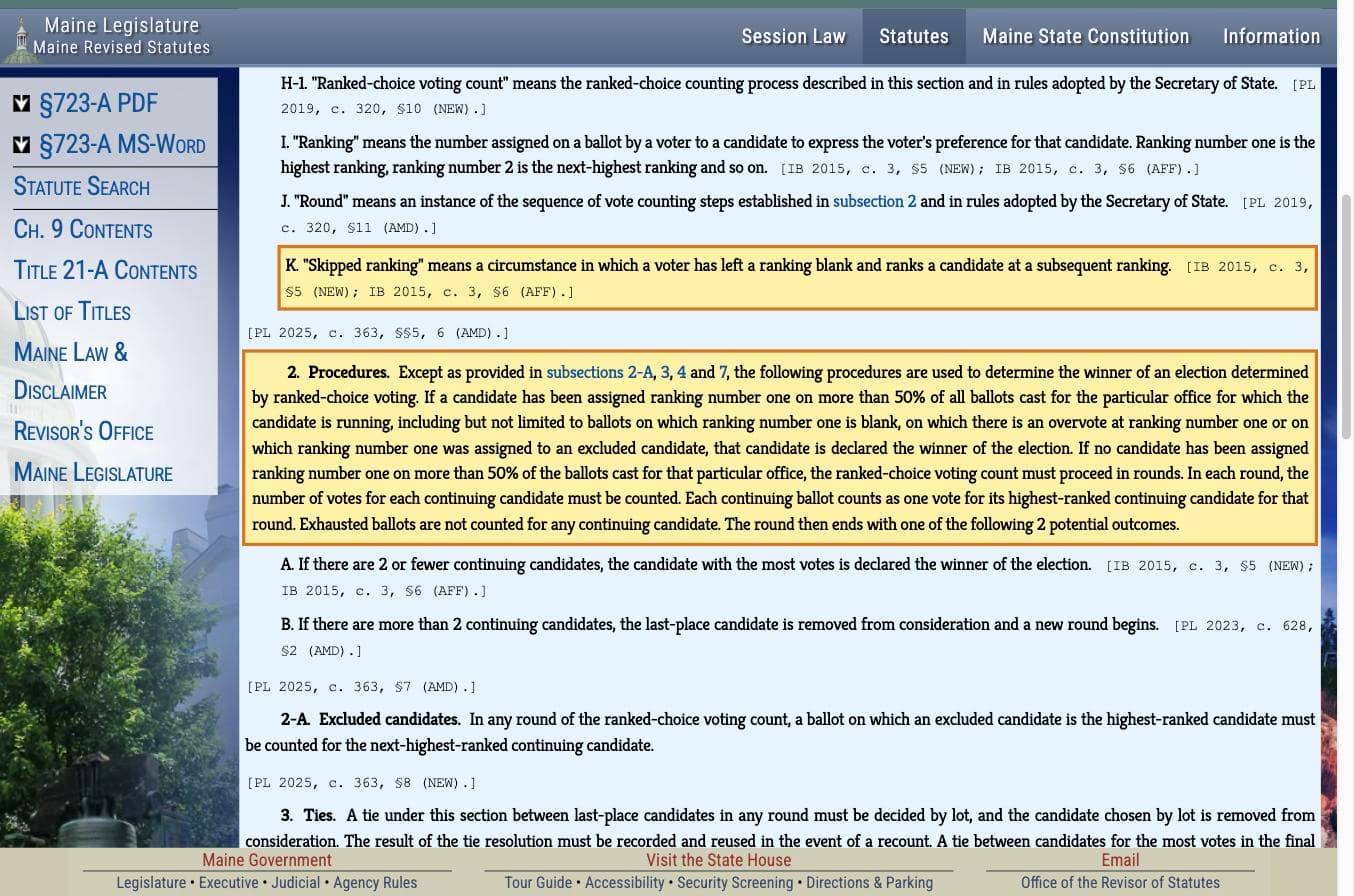
Each continuing ballot counts as one vote for its highest-ranked continuing candidate for that round.
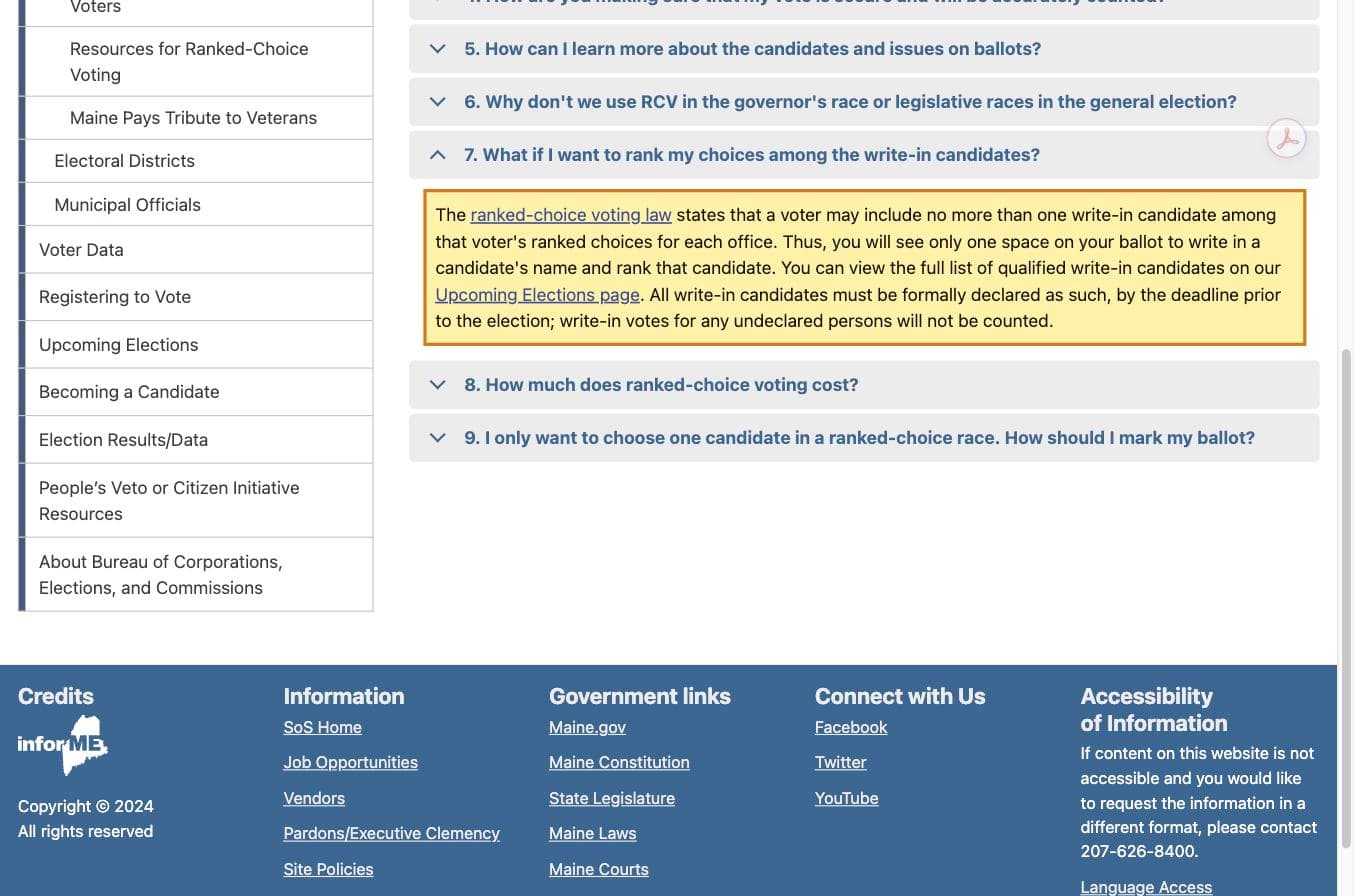
All write-in candidates must be formally declared as such, by the deadline prior to the election; write-in votes for any undeclared persons will not be counted.
— Maine Secretary of State — Ranked-Choice Voting FAQ, Q7
That is the Secretary of State's own answer, on the Secretary of State's own website, in plain words.
That is the mechanism. Writing a name in cannot spoil your ballot, cannot exhaust it, and cannot help the candidate you like least.
We are not pretending this ends with Graham Platner in the Senate.
156,084 people voted in June and the result was set aside. A write-in is the only instrument left that registers those people as still here — not persuaded, not moved on, not gone.
That is a record of the health of an election, written by the voters themselves, in the only place the state is obliged to look. It is not a symbolic gesture and it is not nothing.
Why the deadline mattered
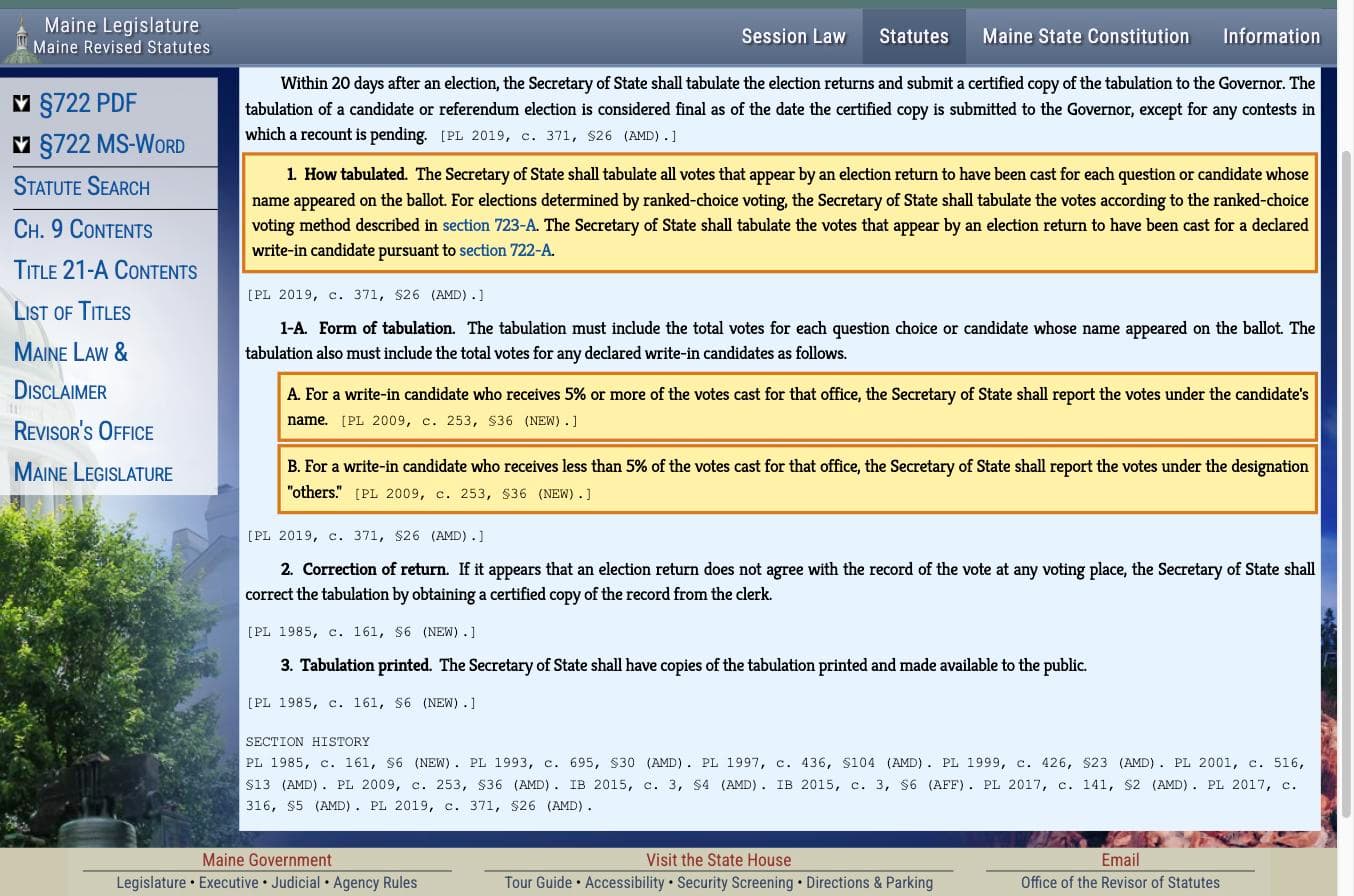
The Secretary of State is required to tabulate write-in votes for a DECLARED write-in candidate. Graham did not declare, and for someone who did not, the statutes require no per-name total at all. Those marks may end up folded in with the blanks. What the law does require, in a ranked-choice race, is that the state publish the complete ballot-level record once results are certified. So the record gets made. Whether anyone reports it under his name is a separate fight, and it is one for after November.
For a candidate who did declare, at 5% or more of the votes cast for the office that total is published under their own name; below 5% it is reported as "others." That is what declaring buys, and it is why the deadline mattered.
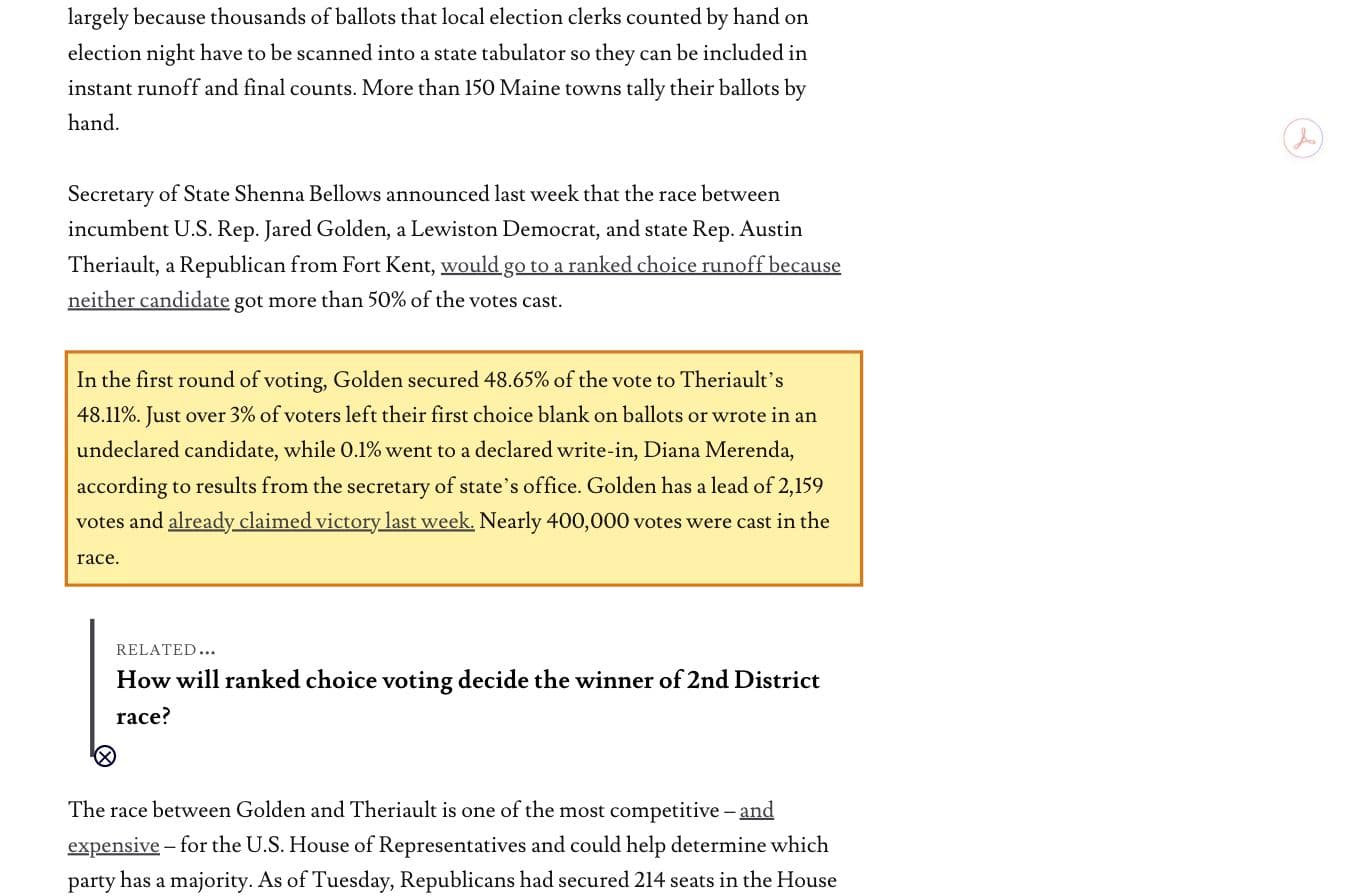
Just over 3% of voters left their first choice blank on ballots or wrote in an undeclared candidate, while 0.1% went to a declared write-in, Diana Merenda, according to results from the secretary of state's office.
— Portland Press Herald, November 12, 2024
The undeclared write-ins are not reported as a number of their own. They are counted in with the blanks. The declared write-in has a name and a figure printed beside it. Same election, same night, same office.
Would a total ever be published under his name?
This is the one thing the statutes do not settle, and it is a reporting question, not a counting one. §722(1) requires the Secretary of State to tabulate write-in votes for a DECLARED write-in candidate, and §722(1-A) reports that total under the candidate's own name at 5% or more, or as "others" below it. For someone who has not declared, the sections are simply silent — nothing requires a per-name total, and nothing forbids one. So the marks may be recorded only as invalid votes, or as write-ins in general, with no figure ever attached to his name. Anyone who tells you the law guarantees such a number, or prohibits it, is going past the text.
To be exact about the scope: the uncertainty is only whether anyone publishes a figure under his name, or whether those marks are reported as invalid votes or as write-ins in general. It is not uncertainty about whether the votes are spoiled, whether the ballot survives, or whether a second choice still lands. Those are settled above.
The people who can answer it are the Maine Division of Elections, at 207-624-7650. If you get an answer, we would rather publish theirs than ours.
Read it yourself
- 21-A M.R.S. §722-A(1) — step 1
- 21-A M.R.S. §696(2)(E) — step 2
- 21-A M.R.S. §723-A(1)(K) — step 3
- 21-A M.R.S. §723-A(1)(D) — step 4
- 21-A M.R.S. §723-A(2) — step 5
- 21-A M.R.S. §722(1) — who gets tabulated
- 21-A M.R.S. §722(1-A)(A)–(B) — the 5% reporting rule
Last updated August 25, 2026. Corrections welcome and made in public: hi@WriteInGrahamForME.com.